
Festive Excuse to Break Out the Drinking Horn
13th Mar 2015
For beer historians, the Medieval era was a fascinating time. Roger Protz of The Herts Advertiser discusses this in a recent article titled “Back to the Middle Ages for brewery.”
According to Protz, “Gruit or gruut is a word of Flemish or Dutch origin and refers to a collection of herbs and spices once used in the brewing process. Until the Reformation, gruit was controlled by the church and brewers had to go, cap in hand, to the local bishop to get their supplies. In Cologne, the archbishop kept strict control through a decree known as the Grutrecht and in Russia Archduke Vassili II banned the use of hops. A similar situation existed in England. In the 15th century, Flemish weavers settled here and started to grow hops but there was fierce resistance to the plant. Its use was banned in Norwich and the authorities in Shrewsbury forbade ‘this wicked and pernicious weed’. Gruit was so entrenched in medieval society that it was even used as currency: the old English coin, the groat, had its roots in gruit. The situation changed as the power of the church waned. Commercial brewing developed and brewers preferred to use hops for both bitterness that balanced the biscuit character of malt and also for the plant’s preservative qualities.”
Protz goes on to discuss the subject of the article’s specific recipe. He writes, “Richard also uses hops in his Gruit, as some medieval beers he has tasted had a sour note as a result of oxidation: hops keep beer in drinkable condition for longer. In keeping with the principles of Foragers, he uses hops grown in his own garden and he thinks they are from the Kent Goldings variety. He says the 4.1 per cent beer went down well with drinkers and diners at the pub. ‘We sold out quickly,’ he adds, ‘and many customers came back asking for more.’ As a result, he plans to stockpile ingredients so he can brew all year round. In the spring he will use sorrel and mint in his beer, with berries and nuts in the autumn. I found the beer a delight to drink. It has a fine copper colour, a good head of foam and a rich spicy, herbal and smoky aroma and palate. The finish is dry and has an intriguing hint of ginger, even though it’s not used in the beer. Gruit clearly makes a fine companion for rich and spicy dishes in the pub.”
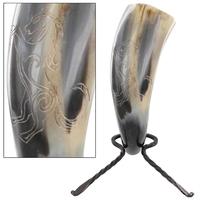
If you’re looking to partake in Medieval brewing history, what better way to do it than with an Untamed Stallion Medieval Dining Hall Drinking Horn from Armory Replicas? This drinking horn is hand polished with a stallion carved into the surface. It includes a twisted iron stand designed to work with almost any horn size. Traditionally, horns from cows, buffalo or oxen have been used as drinking vessels by various people in many regions of the world. This specimen is a great example of the practice.
Whatever replica armory or historical item needs you might have, you can’t go wrong with Armory Replicas!