
Medieval Scissors and the Significance of Haircuts
16th Feb 2015
Scissors have a rich history in medieval history. Simon Coates of History Today explores an aspect of this history in an article titled “Scissors or Sword? The Symbolism of a Medieval Haircut.”
Coates writes, “Whilst residing in Paris in the sixth century, Queen Clotild, the widow of the Merovingian ruler Clovis, became the unwilling subject of the inveterate plotting of her sons, Lothar and Childebert, who were jealous of her guardianship of her grandsons, the children of their brother, Chlodomer. Childebert spread the rumour that he and his brother were to plan the coronation of the young princes and sent a message to Clotild to that effect. When the boys were dispatched to their uncles they were seized and separated from their household. Lothar and Childebert then sent their henchman Arcadius to the Queen with a pair of scissors in one hand and a sword in the other. He offered the Queen an ultimatum. Would she wish to see her grandsons live with their hair cut short, or would she prefer to see them killed? Beside herself with grief, Clotild stated that if they were not to succeed to the throne she would rather see them dead than with their hair cut short. Rejecting the scissors, she opted for the sword.”
 For most of us, this story would seem odd, to say the least. However, it has huge symbolic importance in medieval history. According to Coates, “In the world of Merovingian Gaul, however, the story had a potent resonance and hair itself was of the utmost importance. The Merovingian kings, who had established themselves in the ruins of Roman Gaul, were known as the Reges criniti, the long-haired kings. For them, their long hair symbolised not only their aristocratic status but also their status as kings. It was invested with a sacral quality and believed to contain magical properties. The ultimatum offered by Lothar and Childebert thus hit straight to the heart of Merovingian high politics. What they were effectively saying was 'Do you wish to live non-regally or to die?'. Determined to compromise their nephews' rights to rule they utilised the scissors as a potent symbolic weapon. In sixth-century Gaul a haircut meant political coercion and social exclusion. If you removed the long hair of a king, you removed his claims to kingship itself.”
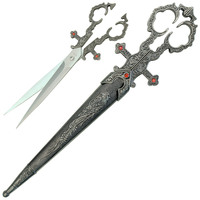
If you’re looking to engage with this history, the Renaissance Medieval Scissors Silver Dagger from Armory Replicas is the product for you. These scissors feature a 440 Stainless Steel Design. It has a silver handle with a cruciform design. Also, it comes with an ornate Silver sheath with red stone. Lastly, both the scissors and the sheath are detailed with complex scroll work.
If you’re a medieval history enthusiast, this is a must for your collection. Whatever replica armory needs you might have, you can’t go wrong with Armory Replicas!